How to Walk Into the Counter Prepared
A five-minute counter conversation can save you two trips, if you bring the right three things with you.
September 9, 2026 · 2 min read
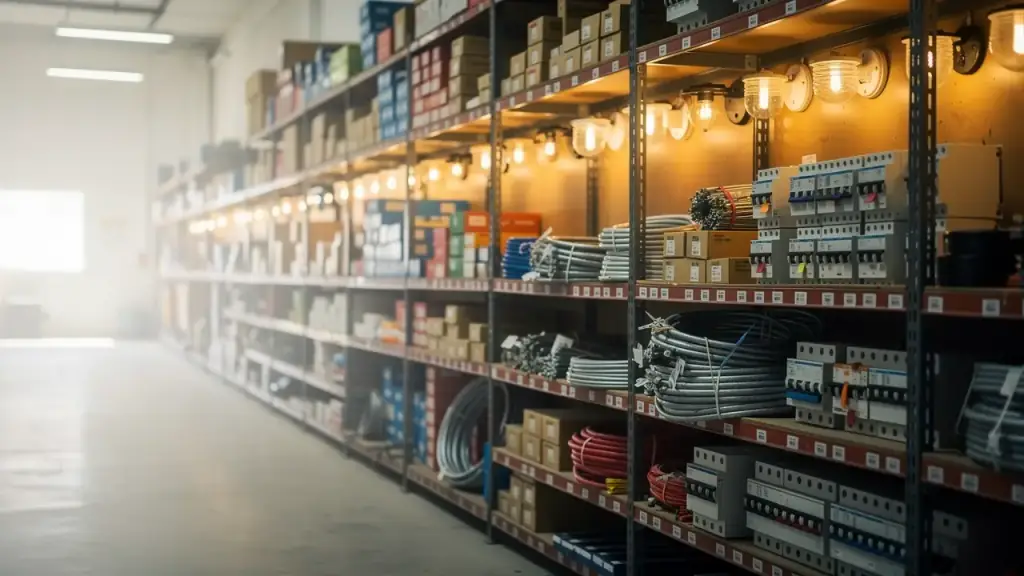
Most trips to a supply counter go one of two ways. Either the customer brought enough information that the visit takes five minutes, or they didn't, and it turns into a round trip home and back. The difference almost never comes down to knowing the technical name for anything. It comes down to bringing the physical evidence.
Bring the old part, not just a description
"It's a round fixture, kind of brass" describes about four hundred products. The actual broken switch, the burned-out ballast, the fixture base with the bracket still attached, tells the counter everything a description can't: the exact mounting pattern, the wire gauge, the finish, the manufacturer stamp if there is one. If it's small enough to carry, bring it. If it's a whole fixture stuck to a ceiling, see the next section.
Read whatever number is stamped on it
Most electrical parts have a part number, a model number, or a UL/manufacturer code stamped or printed somewhere on the housing, base or label. It's often small and in an unhelpful spot, on the underside of a fixture base, on the side of a breaker, on a sticker inside a fan housing. Finding it before the trip and writing it down, or photographing it, turns a guessing exercise into a five-second lookup.
A photo does most of the work when the part can't travel
A chandelier bolted to a 12-foot ceiling isn't coming to the counter with you. A clear photo is the next best thing, and it's worth taking a few, not one: the whole fixture from a few feet back, a close-up of the mounting hardware or canopy, and a close-up of any printed numbers or labels. Good light matters more than a fancy camera. A photo taken straight-on in daylight beats a dim, angled one from a phone flash every time.
- One full shot of the fixture or fitting from a few feet away
- One close-up of the mounting hardware, canopy or base
- One close-up of any part number, model number or manufacturer stamp
- The room's rough dimensions if you're planning a layout, not just replacing one item
Measure the room, not just the fixture, for a planning job
If the trip is about lighting a whole room, a kitchen, a family room, a patio, rather than swapping one fixture, bring the room's dimensions and ceiling height, not just the size of the old fixture. Arrow offers layout and planning assistance for exactly this kind of job, and a counter conversation about spacing and coverage is a lot more useful with real numbers than with "it's a medium-sized kitchen."
None of this is about being an expert
You don't need to know a ballast from a driver or a canopy from a base plate before you walk in. That's what the counter is for. Bringing the part, the number and the photo just means the conversation starts from the same information the person behind the counter is trained to work with, whether that's at Bel Air, Aberdeen or Elkton. If any part of the job involves actually running new wire or touching a panel, the counter will say so plainly, that's work for a qualified electrician, not something to take on from a parts list.
Arrow Electrical Supply Co., Inc., 410-838-2271
Call 410-838-2271More articles
What a Supply House Carries That a Home Center Doesn't
The big box aisle is built for one kind of shopper. A supply counter is built for the job in front of you.
Buying a Standby Generator, Honestly
A generator is a real purchase decision. Here's what that decision actually involves, and what it doesn't.